Best Sunscreen for Oily Skin in Pakistan (2026): No Shine, No White Cast, No Breakouts
Novelax PharmaIf you have oily skin in Pakistan, you've probably tried sunscreen once, hated it, and quietly stopped. We hear this all the time: "It made my face shine like a mirror by 11am." "It gave me pimples." "It left a white film and my colleague asked if I was unwell." So you skip it, and every summer your skin gets a little darker, the marks from that one breakout stay a little longer, and the pigmentation creeps in. Then you buy a brightening cream to fix what the missing sunscreen caused.
This guide is for you. We make a sunscreen, so we obviously have an opinion — but the goal here is simple: help you understand why sunscreens go wrong on oily skin, what to actually look for on the label, and how to wear SPF in Lahore in June without looking like you've been fried in ghee.
Why oily skin needs sunscreen more, not less
There's a myth that oily skin is "protected" because it's thicker or produces more sebum. It isn't. Oily skin in Pakistan tends to come with three things: acne, the dark marks acne leaves behind, and enlarged pores. UV makes every one of those worse. Sun turns a pink acne mark into a brown one that takes months to fade. Sun triggers more oil production as the skin tries to defend itself. And sun breaks down collagen, so the pores that look big at 25 look bigger at 35.
Every brightening product we sell — Vitamin C, Alpha Arbutin, Glutathione, Niacinamide — works about half as well without sunscreen. Some customers use a Rs. 1,200 night cream religiously and skip a Rs. 800 sunscreen, and then tell us the cream "didn't work". It did. The sun undid it every morning.
Why most sunscreens feel terrible on oily skin
Three reasons, and once you know them, the label starts making sense.
Heavy oils and butters. A lot of sunscreens are built on a moisturiser base meant for dry European skin. On a face that's already producing plenty of oil in 38°C humidity, that's like wearing a jacket in June.
Comedogenic ingredients. Certain thick emollients (coconut oil, some waxes, heavy silicones in high amounts) sit in pores and cause the breakouts people blame on "sunscreen". It's not the SPF — it's the base.
Too much of the wrong filter. Sunscreens use either mineral filters (Zinc Oxide, Titanium Dioxide) or chemical ones (Octinoxate, Avobenzone and friends). Pure high-dose mineral formulas leave a white cast on our skin tones; some pure chemical formulas feel greasy and sting around the eyes when you sweat. The better formulas for oily skin combine a moderate amount of both.
What to look for on the label (this is the useful part)
Ignore the front of the tube — "oil-free", "matte", "for oily skin" is marketing. Turn it over.
Broad spectrum, SPF 30 to 60. "Broad spectrum" means UVA and UVB. SPF only measures UVB (burning); UVA is what darkens and ages skin, and it comes through windows and clouds. If the tube doesn't say broad spectrum or PA+++, put it back. For Pakistan's sun, SPF 50–60 is the sensible range; above that is mostly marketing.
Lightweight texture: gel, fluid, or a light cream. Squeeze a little on the back of your hand. If it takes more than 20 seconds to disappear, it will sit on your face all day.
Water and sweat resistant. Non-negotiable here. A sunscreen that slides off with the first sweat of the day is protecting your collar, not your face.
Zinc Oxide somewhere in the list. Zinc is mildly oil-absorbing and calming, which is why dermatologists like it for acne-prone skin. A formula that uses zinc alongside a chemical filter gets protection without the full white cast.
Bonus: a brightening ingredient. Niacinamide or Glutathione in a sunscreen means your morning SPF is also working on marks and tone. One product, two jobs — fewer layers on oily skin is always better.
Avoid: alcohol high on the list (dries you out, then your skin makes more oil), heavy fragrance if you're acne-prone, and anything that doesn't list ingredients at all.
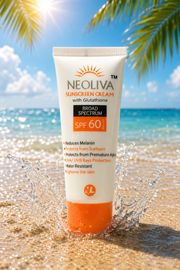
Our pick for oily skin: Neoliva SPF 60
We'll be upfront: Neoliva SPF 60 Sunscreen Cream is ours, so take this as a description, not a review. It's built for the checklist above, because the checklist above is what our customers with oily skin kept asking for.
It's broad spectrum, SPF 60, water resistant. The filters are a mix — Zinc Oxide and Titanium Dioxide for the mineral side, Octyl Methoxycinnamate for the chemical side — so you get high protection without a heavy white layer. It's a light cream that spreads thin and settles to a soft, non-shiny finish rather than a wet look. There's Witch Hazel Extract in it, which is a gentle astringent that helps keep the surface from going greasy through the day. And it has Glutathione, so it's quietly working on tan and marks while it protects.
The honest caveats: it's a cream, not a watery gel, so if your skin is very oily you'll want a thin, even layer rather than a thick one. And like every sunscreen ever made, it does not stay on through eight hours of Karachi humidity without a top-up — nothing does. It's Rs. 855, Cash on Delivery.
How to wear sunscreen on oily skin without the shine
This is where most people go wrong, and it's fixable in a week.
Morning
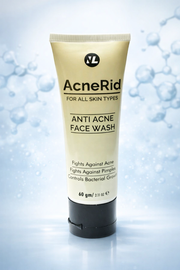
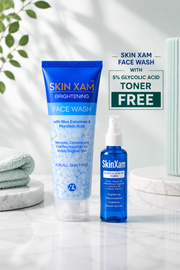
Start with a face wash that actually clears oil rather than just foaming — a salicylic acid wash like Acnerid if you break out, or Skin Xam Brightening Face Wash if your main issue is dullness. We wrote a whole piece on choosing a face wash for oily skin if you want the detail.
Pat dry. If you use a Vitamin C serum, two drops now, then wait a minute. Skip the moisturiser — on oily skin in summer, a good sunscreen is your moisturiser. This one change fixes half the shine complaints we get.
Then sunscreen: about two finger-lengths for face and neck. Yes, that much. Most people use a quarter of the amount and get a quarter of the SPF. Spread it in a thin, even layer, let it settle for two or three minutes before makeup or before leaving the house.
Through the day
If you're indoors near a window, once in the morning is fine. If you're outside, on a bike, or in a car for hours — reapply every two to three hours. Nobody does this perfectly; do it at lunch and you're already ahead of 95% of people. Blot the shine with tissue first, then reapply a thin layer.
Night
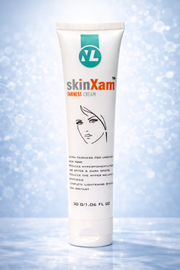
Wash it off properly. Sunscreen left on overnight is a very common cause of "my sunscreen gives me pimples". Double cleanse if you wore makeup over it. Then your night treatment — Acnerid Cream on active spots, or Skin Xam Fairness Cream for marks.
"But it still makes me shiny"
A few things to check before blaming the sunscreen:
Are you layering a moisturiser under it? Stop for a week and see.
Are you washing with something harsh that strips oil, so your skin over-produces by 10am? Switch to a gentler wash and the shine often drops.
Are you using far too much in one thick layer? Two thin layers a minute apart wear better than one thick one.
And finally — some shine is just weather. If it's 40°C and 70% humidity, everyone is shiny. A tissue at noon fixes it. Skin that shines a little but is protected beats matte skin that's getting darker every day.
Sunscreen and makeup on oily skin
Sunscreen goes on first, always, after it's had a couple of minutes to set. A light-cream sunscreen like Neoliva works fine under foundation; if you've had pilling problems, it's usually because the sunscreen was still wet or the layers were too thick. Powder on top helps set everything. And no, the SPF in your foundation doesn't count — you'd need to apply it like plaster to reach the number on the bottle.
Frequently Asked Questions
Which sunscreen is best for oily skin in Pakistan?
One that is broad spectrum (UVA + UVB), SPF 50–60, lightweight, water resistant and ideally contains Zinc Oxide with a brightening ingredient like Glutathione or Niacinamide. Neoliva SPF 60 meets all of these and settles to a non-greasy finish.
Does sunscreen cause acne on oily skin?
The SPF itself doesn't. Heavy oils in the base, or sunscreen left on overnight, can. Choose a lightweight formula and wash it off properly at night.
Is gel sunscreen or cream sunscreen better for oily skin?
Gels feel lighter but often have less water resistance and lower SPF. A light cream with a mineral-plus-chemical filter usually gives better protection in Pakistan's heat. Apply it thin and it wears like a gel.
What SPF should I use in Pakistan?
SPF 50–60, broad spectrum. Our UV index is high most of the year; SPF 15–30 is not enough for daily outdoor exposure.
Do I need sunscreen indoors or in winter?
Yes. UVA passes through glass and clouds and is the main cause of tanning and pigmentation. If you sit near a window or drive, you need it. Winter sun in Pakistan is still strong.
Can I skip moisturiser and use only sunscreen on oily skin?
In most cases, yes — a good sunscreen provides enough hydration for oily skin in summer. Add a light moisturiser only if your skin feels tight.
How much sunscreen should I apply?
About two finger-lengths for the face and neck. Using less gives you a fraction of the SPF on the label.
Does Neoliva SPF 60 leave a white cast?
Applied in a thin, even layer it settles clear on Pakistani skin tones. A thick layer of any mineral-containing sunscreen can look slightly white for a minute before it sets.
The short version
Oily skin in Pakistan needs sunscreen more than any other skin type, because every problem it has — acne marks, pigmentation, pores — is made worse by the sun. The trick isn't finding a "matte" sunscreen; it's picking a light, water-resistant, broad-spectrum formula, skipping the moisturiser underneath, using enough of it, and washing it off at night. Do that for two weeks and the shine complaints usually disappear on their own. If you want to start with ours, Neoliva SPF 60 is Rs. 855, Cash on Delivery across Pakistan, Rs. 250 flat delivery in three to four working days. Questions? The WhatsApp button is right there.