

Best Face Serum for Glowing Skin in Pakistan: 10 Ingredients Compared
Novelax PharmaYou walk into a shop in Saddar or scroll through Instagram, and someone hands you a serum. It promises glow in seven days. The bottle is pretty. The price is Rs. 2,500.
Here is the uncomfortable part: you have no idea what is inside it, and neither does the person selling it to you.
Almost every "glow serum" sold in Pakistan is built from the same eight or nine ingredients. Once you can read those names on a label, you stop buying brands and start buying what your skin actually needs. That is what this guide is for.
Below are the ten ingredients that matter, what each one genuinely does, who should skip it, and roughly what you should expect to pay. We make two of these serums ourselves — we have said so clearly where that applies, and we have also included ingredients we do not sell, because a list that only mentions our own products would be useless to you.
How to read a serum label in 30 seconds
Three rules, and they will save you a lot of money.
1. The first five ingredients are the product. Everything after that is usually present in tiny amounts. If "Vitamin C" appears second from the bottom, it is there for the label, not for your skin.
2. A serum is water-thin and targeted. If it feels like a cream, it is a cream. Serums carry a high concentration of one or two actives and nothing else. That is the whole point of the category.
3. Glow is mostly hydration plus even tone. Skin that looks dull is usually dehydrated, slightly sun-damaged, or both. No serum makes skin "fair". The good ones fade what should not be there and let your own skin show.
The 10 serum ingredients that matter in Pakistan
1. Vitamin C — the one worth starting with
The most tested brightening ingredient there is. It fades dark spots, defends against the pollution and UV that create new ones, and supports collagen.
The catch is that "Vitamin C" means three different things:
- L-Ascorbic Acid — strongest, but it oxidises fast. If your serum has turned orange or brown, it is finished. In Pakistani heat this happens quickly.
- Ethyl Ascorbic Acid — stable, absorbs well, far less fussy about storage. The sensible choice for this climate.
- Sodium Ascorbyl Phosphate — the gentlest. Slower, but it suits sensitive and acne-prone skin.
Use it: morning, under sunscreen. Expect: brighter skin in 3–4 weeks, spots fading at 6–8.
Who should skip it: nobody, really — but if your skin stings, you need the gentler form, not a different ingredient.
2. Alpha Arbutin — for dark spots specifically
Where Vitamin C brightens everything a little, Alpha Arbutin goes after pigment directly. It slows the enzyme that produces melanin, so existing marks fade and new ones form more slowly.
It is gentle. It does not sting, it does not peel, and sensitive skin tolerates it. The trade-off is patience — this is a 6 to 8 week ingredient, not a two-week one.
Best for: acne marks, melasma, sun spots, uneven tone.
3. Niacinamide — the all-rounder for oily skin
Niacinamide (Vitamin B3) controls oil, calms redness, strengthens the skin barrier, and makes pores look smaller because there is less congestion inside them.
Around 5% is the useful range. Serums advertising 10% or 20% are not better — above roughly 5% many people get flushing and irritation with no extra benefit.
Best for: oily, combination and breakout-prone skin, especially in Karachi and Lahore humidity.
4. Hyaluronic Acid — the one everyone misuses
Hyaluronic Acid does not add moisture. It pulls moisture and holds it. That distinction matters here.
Apply it to damp skin and seal it with a moisturiser, and your skin looks plump within minutes. Apply it to dry skin in a dry room with nothing on top, and it can pull water out of your skin instead. In winter, in an air-conditioned office, that is a real risk.
Rule: damp skin, then moisturiser on top. Always.
5. Ferulic Acid — the quiet one that makes others work
Ferulic Acid does little on its own and it is rarely the headline. What it does is stabilise Vitamin C and extend its antioxidant effect.
If you see Ferulic Acid alongside Vitamin C on an ingredient list, that is a sign the formula was thought about rather than thrown together.
6. Licorice and Mulberry extract — gentle brightening
Both are plant extracts that reduce pigment production. They are mild — nobody fixes melasma with licorice alone — but they work well as support ingredients, and they almost never irritate.
Best for: sensitive skin that reacts to stronger brighteners.
7. Kojic Acid — stronger, and riskier
Derived from fermented rice, Kojic Acid is a more aggressive pigment blocker than Arbutin. It works faster on stubborn marks.
It also irritates more, and it degrades in sunlight. If you use it, night only, and sunscreen is not optional. We do not put Kojic Acid in our serums for this reason — it sits better in a night cream, where it is not fighting the sun.
8. Glycolic and Mandelic Acid — exfoliation, not brightening
These are AHAs. They dissolve the glue holding dead cells on the surface. The "instant glow" people report after an acid is simply the removal of a dull layer.
Glycolic is the smallest molecule and the most effective — and the most likely to burn. Mandelic is a much larger molecule, so it penetrates slowly and suits sensitive and darker skin far better.
Twice a week is plenty. Daily acid use is how people end up with a damaged barrier and skin that is red, tight and worse than when they started.
9. Retinol — the strongest thing on this list
For fine lines, texture and long-term acne, nothing else in this list comes close. Decades of research support it.
It is also the one that causes the most trouble. Expect dryness and flaking for the first few weeks. Night use only. Do not use retinol if you are pregnant or breastfeeding. Start twice a week, not daily.
We do not make a retinol serum. If you want one, buy from a pharmacy that stores stock properly and start low.
10. Peptides — slow, steady, no drama
Peptides such as Matrixyl 3000 signal the skin to produce more collagen. The effect is gradual and subtle — this is a maintenance ingredient, not a fix.
Worth having in a formula. Not worth paying a premium for on its own.
Quick comparison
| Ingredient | Main job | When | Results in |
|---|---|---|---|
| Vitamin C | Brightening, antioxidant | Morning | 3–4 weeks |
| Alpha Arbutin | Dark spots, melasma | Either | 6–8 weeks |
| Niacinamide | Oil, pores, redness | Either | 2–4 weeks |
| Hyaluronic Acid | Hydration | Either | Same day |
| Ferulic Acid | Stabilises Vitamin C | Morning | Support only |
| Licorice / Mulberry | Gentle brightening | Either | 6–8 weeks |
| Kojic Acid | Stubborn pigment | Night | 4–8 weeks |
| Glycolic / Mandelic | Exfoliation, texture | Night, 2x week | 2–3 weeks |
| Retinol | Lines, texture, acne | Night | 8–12 weeks |
| Peptides | Collagen support | Either | 8–12 weeks |
So which serum should you actually buy?
Pick by your main complaint, not by the longest ingredient list.
- Dull skin, no specific marks → Vitamin C, morning.
- Acne marks and dark spots → Alpha Arbutin, or Vitamin C and Arbutin together.
- Oily skin and large-looking pores → Niacinamide.
- Tight, flaky, dehydrated skin → Hyaluronic Acid, sealed with a moisturiser.
- Rough texture, early lines → Retinol at night, slowly.
- Melasma → see a dermatologist. Melasma is managed, not cured, and the wrong product makes it worse.
Our two serums, and who they are for
We make two face serums. Here is the honest positioning.
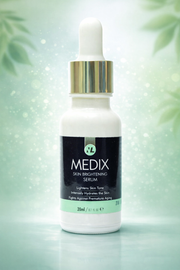
Medix Skin Brightening Serum — Rs. 1,965
Medix Skin Brightening Serum combines Alpha Arbutin with Sodium Ascorbyl Phosphate (the gentle Vitamin C), plus Ferulic Acid and Hyaluronic Acid.
That pairing is deliberate: Arbutin handles existing spots, the gentle Vitamin C defends against new ones, Ferulic Acid keeps the Vitamin C working, and Hyaluronic Acid stops the formula feeling tight.
Choose this if your main problem is dark spots, acne marks or uneven tone, and your skin is on the sensitive side.
Skin Xam Vitamin C Serum — Rs. 1,875
Skin Xam Vitamin C Serum is built on Ethyl Ascorbic Acid — the stable form that survives our climate — with Matrixyl 3000 peptides, Licorice and Mulberry extracts, and Sodium Hyaluronate.
Choose this if your skin is dull rather than spotted, you want an everyday morning serum, and you would like the peptide support for texture.
If you cannot decide: the Skin Xam serum is the better daily starting point. The Medix serum is the better choice if you have specific marks you want gone.
What no serum will do
This part matters more than the rest of the article.
No serum changes your natural skin colour. Anything advertised as making you "fair" or "white" is either lying or contains something it should not. In Pakistan that often means mercury or a strong steroid — both of which thin the skin, cause rebound pigmentation, and do lasting damage. If a cream works in three days, that is the warning sign, not the selling point.
No serum survives without sunscreen. UV creates pigment faster than any ingredient fades it. Using a brightening serum and skipping sunscreen is paying for work you then undo every afternoon. This is the single most common reason people say "it didn't work".
No serum works in a week. Skin turnover takes roughly 28 days, and pigment sits deeper than one cycle. Four to eight weeks is the honest range. Anything faster is surface exfoliation, not a real change.
More serums is not better. Two actives, used consistently, beat six used randomly. Layering acids with Vitamin C with retinol is how people damage their barrier.
How to use a serum so it actually works
- Cleanse. A serum cannot get through oil and sunscreen residue.
- Apply 2–3 drops to slightly damp skin — damp, not wet.
- Press it in rather than rubbing. Let it absorb for a minute.
- Moisturiser on top, to hold it there.
- In the morning, sunscreen last. Always.
Thinnest to thickest, if you are using more than one product. And give any new serum six weeks before you decide it has failed.
Frequently asked questions
Which serum is best for glowing skin in Pakistan?
For most people, a stable Vitamin C serum used every morning under sunscreen. If your main issue is dark spots rather than general dullness, Alpha Arbutin is the better target. Glow usually comes from hydration plus even tone, not from one miracle ingredient.
Can I use two serums together?
Yes, but keep it to two and apply the thinner one first. Pair Vitamin C with Hyaluronic Acid, or Niacinamide with Alpha Arbutin. Avoid stacking exfoliating acids with retinol or Vitamin C in the same routine.
How long before a face serum shows results?
Brightness in 3 to 4 weeks. Dark spots in 6 to 8 weeks, and only with daily sunscreen. Fine lines and texture take 8 to 12 weeks.
Is serum necessary, or is a moisturiser enough?
If your skin is healthy and you have no specific concern, a moisturiser and sunscreen are enough. A serum earns its place when you have something to target — marks, dullness, oil, early lines.
Which serum is best for oily and acne-prone skin?
Niacinamide for oil control, or a gentle Vitamin C such as Sodium Ascorbyl Phosphate. Avoid heavy oil-based serums, and treat the acne itself separately rather than expecting a brightening serum to clear it.
Do brightening serums work on melasma?
They help, but melasma is hormonal and deeper than ordinary pigmentation. It is managed long term with a dermatologist and strict daily sunscreen, not cured by a serum.
Can I use a serum in summer?
Yes. Choose lightweight water-based formulas, keep Vitamin C for the morning under sunscreen, and store bottles away from heat and direct light.
Read next
- Alpha Arbutin vs Niacinamide — which one for your skin
- Dark spots and pigmentation treatment in Pakistan
- How to tell a steroid-free cream from a steroid one
- Choosing a sunscreen in Pakistan
Shop the serums in this guide: Medix Skin Brightening Serum · Skin Xam Vitamin C Serum · all Vitamin C products
Cash on Delivery across Pakistan. Rs. 250 flat delivery, 3–4 working days. Every product is dermatologically tested, steroid and mercury free, with a full ingredient list, batch number and expiry on the pack.
1 comment
Helpful guide! Understanding ingredients before buying a product is always a smart choice. In the same way, parents can choose meaningful playtime options like building blocks for kids from Toynix, which encourage creativity, problem-solving, and hands-on learning while keeping children entertained.